Generative AI moved fast, but it stayed conversational. You asked, it answered. In 2026 the value has migrated up the stack: instead of a single model in a single chat window, organisations deploy fleets of specialised agents that plan, delegate, call tools, hand off intermediate state, and finish multi-step jobs without human intervention. This is the shift from generative AI to agentic AI — and it is reshaping how digital products are built.
What 'agentic' actually means
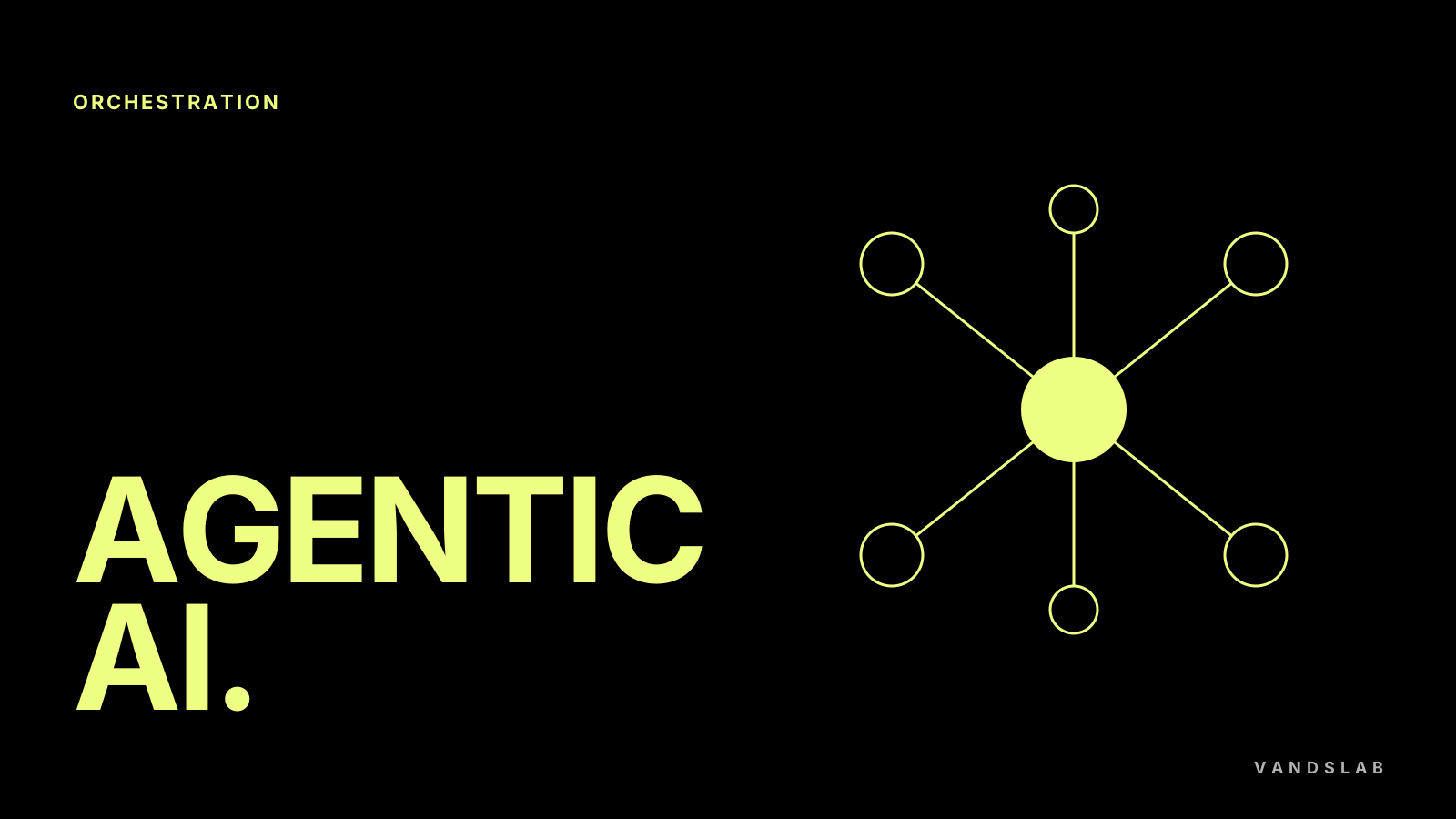
An AI agent is an LLM-driven runtime with three properties: it has a goal, it can choose tools to advance that goal, and it can decide when it is done. A multi-agent system composes several of these runtimes around a shared task — an orchestrator delegates, specialists execute, a verifier reviews. The architecture closely mirrors how human teams operate, which is exactly why it scales to real workflows.
Four orchestration patterns that work in production
- Supervisor / worker — a planner agent decomposes the task and routes subtasks to typed specialists.
- Sequential pipeline — agents pass artefacts down a deterministic chain, each adding a layer (retrieve → draft → critique → publish).
- Group chat — agents share a transcript, take turns, and converge on output through structured debate.
- Reflection loop — an actor agent proposes, a critic agent rejects, the actor refines until quality thresholds pass.
A real workflow: invoice processing without humans
Consider an accounts-payable flow. Agent A ingests inbound mail and extracts structured invoice data. Agent B reconciles line items against the purchase order in the ERP. Agent C runs the fraud and policy checks. Agent D writes the payable into the ledger and triggers the bank instruction. A supervisor agent owns the end-to-end SLA and escalates only the genuine anomalies. The team that used to handle 200 invoices a day now reviews 6 exceptions.
What you need before you start
- A typed tool layer — every external action (API call, DB write, email) wrapped behind a strict schema.
- Observability built for non-determinism — trace each agent decision, retry, and tool call.
- A sandbox environment — agents must rehearse against synthetic data before touching production state.
- Cost controls — token budgets per task, hard ceilings per workflow run.
Agentic AI is not a model upgrade — it is an architectural decision. Done right, it compresses days of human coordination into minutes of machine collaboration. Done badly, it produces beautifully autonomous failure at scale. Pick the workflow, draw the agent boundaries, and ship the smallest valuable loop first.
Have a workflow worth automating end-to-end, or a question about agentic architecture? Reach out via the contact section.
Frequently asked questions
- Generative AI produces content in response to a prompt. Agentic AI pursues a goal: it plans, calls tools, evaluates intermediate results, and decides when the task is finished — typically across multiple cooperating agents.
- No. Production systems mix model tiers: a strong reasoning model for planning and critique, smaller and cheaper models for routine extraction and routing. This is essential for unit economics.
- Strict tool schemas, scoped permissions, deterministic guardrails between steps, full tracing, and a hard escalation path to humans on confidence thresholds and policy violations.